"Warning to All Who Dares Enter TLA!!!"
"Cockatiels will control your mind!"
"You will end up in the loony bin!"
"My friends, you have been warned!" (Insert evil laugh here: "BWAHAH!")
Supplying all your bird's needs!
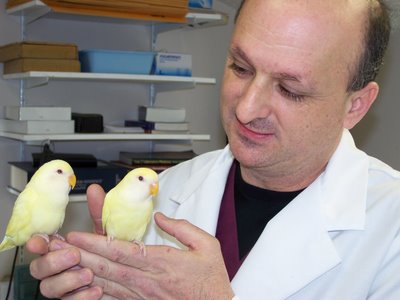
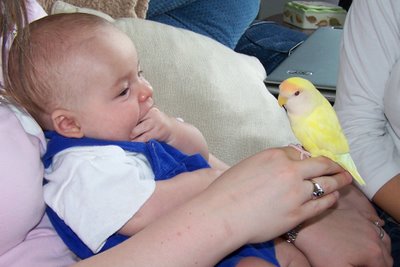
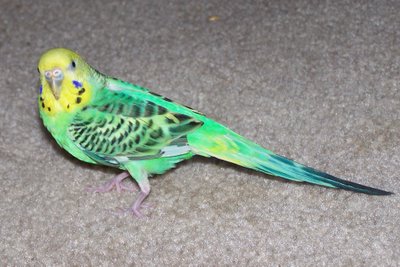
We are the owners of an awesome E-Bird store (stuff for all birds of all sizes!) and Lovebird Aviary in Cary, NC. Our birds are quite popular because of their temperaments and socialization. Our dear Angel passed away on July 30th, 2007 and we lost our Evee on September 11, 2013. We have retired from breeding but are advocates of fostering and adoption!
"Cockatiels will control your mind!"
"You will end up in the loony bin!"
"My friends, you have been warned!" (Insert evil laugh here: "BWAHAH!")
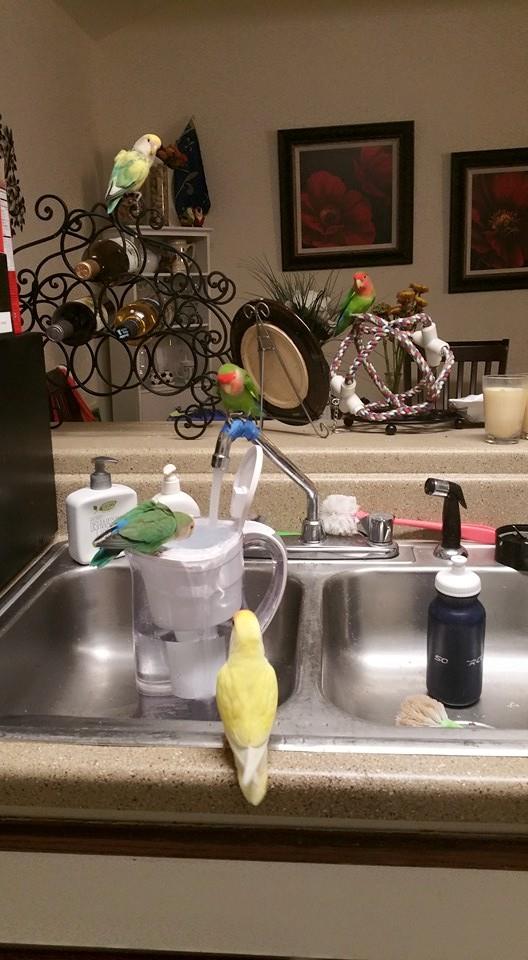
Our birdies just received their brand new toys from Dr. Burkett! Guess which one was their favorite?
Posted by
Tamara
at
6:26 AM
2
comments
Posted by
Tamara
at
5:57 PM
2
comments
Labels: African Grey, conure, Macaw, RDCBS, Skittles, Tootsie
Posted by
Tamara
at
9:21 AM
0
comments
Labels: Creamino, Dutch Blue, Jelly Bean, Pixy, starbuck, Update
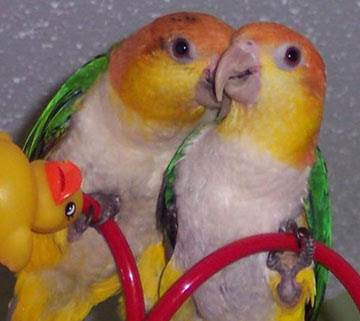
Photo from caiquesarepeopletoo.homestead.com (Trouper and Ripley)
Caiques
By Rodney Money
trueloveaviary@gmail.com
Tamara: “Are you sure we are going the right way?”
Rodney: “Yes, I actually looked up the directions this time, plus, I MapQuested it.”
Tamara: “Hey! Is that it?”
Rodney: “Well, telling by the parrots on the sign that says “Birdie Boutique” in front of the house, I would say so.”
Tamara: “Smart butt.”
Rodney: “Yeah, I know. (LOL.)”
This was the conversation Tamara and I had on our very first adventure to the Birdie Boutique in Durham, NC. We were engaged, broke, and without jobs. I was doing my student teaching for music at Apex High School, and because I knew birds would be in our life after marriage, I was looking for the perfect opportunity to immerse Tamara into the world of bird ownership. The moment we walked across the threshold, the sights and sounds of continents from all around the world resounded in our ears. Cockatoos, cockatiels, and budgies originally from Australia, African greys and Lovebirds with their roots in Africa, and from the New World: macaws, conures, amazons, and a very outgoing Maximilian’s Pionus that thought I was her Daddy. I can still feel those sharp, baby claws on my hand refusing to let go to this day.
We were excited to see that the Birdie Boutique had an open play area that allowed guests to play and help in the socialization of their birds. On the playground, our eyes caught the flashes and hues of emerald greens, tangerine oranges blended with shimmering yellows, and white as the pure, driven snow constantly in motion. As we got closer we saw that it was not just one parrot, but actually two very playful, acrobatic clowns working as one as they manipulated a toy made of wood and leather. We placed our hands near them not meaning to interrupt their play, but as soon as they saw us a new game has just begun; and Tamara and I were the main attraction.
“What kind of birds are these?” Tamara asked.
“Caiques,” I said as Tamara still looked puzzled.
“Pronounce that again, ‘Sweets,’” asked Tamara once again.
“(Ky-EEK’s) my ‘Love,’” I explained.
“Very cool, and so sweet and playful,” she said as she was already plotting on how to take them home.
In disappointment, due to our current status, I explained to her, “Right birds, wrong timing.”
“One day we will have birdies,” I thought, “one day soon.”
Every time I think of caiques I think of my very first meeting and lecture at the Raleigh-Durham Cage Bird Society. With pen and paper in hand, I was trying to digest every word concerning the topic of Nutrition for Our Birds, but in that instant a caique decided to initiate me into the club. As I took notes in my journal, he was wondering why the human got to play with all the cool toys. So he jumped on my lap, grabbed the leather binding holding together all my papers, and proceeded to dismember them. While I willingly gave up my journal to my new friend, more like to his beak, I signaled to his owner that it was completely all right. I was deeply honored that he decided to spend his time with me destroying my personal belongings. Because the caique welcomed me that day, I have been back to the meetings ever since.
Because of their playful, inquisitive, and “always on the go” attitudes, caiques have been called the closest thing to New World Lories. These little, animated clowns are also the parrot version of the hopping kangaroo; often preferring hopping and climbing over flying. They develop extremely strong feet and can be especially obsessed with foot toys. Although their diet consists more of a parrot diet, their high energy levels can rival that of a lory or lorikeet. Just like a young puppy, a caique loves to wrestle and roll a round on their back with their toys, owners, and even other birds. This rough-and-tumble play often surprises people when they catch their caiques wrestling on the bottom of their cages just like two Jack Russell Terriers. Watching them play can be more entertaining than going to the movies.
Caiques that are kept in pairs often act like siblings. If there is a dispute over a toy, treat, or a favorite perch, they will normally make-up and are back being friends in no time. In fact, caiques are known to remain tame even if they have a cage mate as long as there is daily playtime and proper socialization from their owners. Even with all this energy, they share a characteristic often found in the play of Lovebirds. They play hard, but eventually they crash, falling asleep like little babies. Owners have found this to be the perfect time for cuddles, snuggles, and the ever popular head rub. Caiques have even been known to sleep on their backs scaring some owners half to death only to realize that their baby was just acting silly.
These South American little wind-up toys are considered to be a medium sized parrot with a length of 9 inches and weighing somewhere between 170 to 190 grams. They are good as a single pet, but more entertaining in pairs, and do quite well living in apartments. However, some individual birds can have a harsh shrill resembling a whistle. The two main species most commonly found in captivity are the White-bellied Pionites leucogaster and the Black-headed caique Pionites melanocephala. The White-bellied caique we see mostly in the USA is the Yellow-thighed caique Pionites leucogaster xanthomeria. This subspecies has obviously yellow thighs in compared to the nominate race that has green thighs. The Yellow-thighed caique is often referred to as a White-bellied caique. The White-bellied caique is reported to be a bit calmer than the Black-headed caique and a little less high-strung, but calmer and less high-strung is a relative term when taking about the exuberant personality of the caique. With good care, a caique can live more than 20 years in captivity.
Caiques can become stubborn and may get out of control if they get too excited. Many of a parrot enthusiast has reported that the worst bite that they have ever received came not from a macaw or a cockatoo, but from a caique. These mischievous rascals tend not to be shy around strangers, especially if they are seduced by toys or treats, but people need to always stay a step ahead of these intelligent birds. A caique’s temperament has been compared to that of a Scarlet Macaw. Some caiques have been known to be very sweet when picked up, but bite fiercely out of deviance when being put down. Also, caution should be used when introducing a caique to new clothing, hair style, or flashy jewelry. The same bird who seems fearless and could take on the world one second, could suddenly exhibit extreme fear over an inanimate object. Caiques tend to be gregarious amongst their own kind, but can be aggressive when introduced to lesser dominating species. However, I know of at least one household that is not run by the caique, but by a Pacific parrotlet.
Caiques have healthy appetites and can go through a bowl of food in minutes. So an owner needs to make sure that their caique is not losing weight due to not enough food in comparison to their high level of activity. Most caiques love water and are prone to frequent baths even after just receiving a bath. Like conures, caiques benefit from having a tub in which they can bathe, and some even relish “leaf bathing” just like budgies. For one caique a cage measuring 23” wide by 32” long by 64” in height is the absolute minimum with the bar spacing of 5/8” to 3/4”. Larger is always better, and playgrounds outside the cage are a necessity. With a playground, toys, and foraging opportunities, caiques can be very self-entertaining avoiding driving their owners crazy with constant, demanding attention. Caiques are always on the move and tend to use their owners like a moving playground instead of a perch.
Because of their high intelligence, trick training is a great way to keep the mind of a caique busy. Plus, it is easy to entice them because of their love of treats. Some of the most extreme tricks are inspired by play. One example is when owners spin their caiques round and round on a string or piece of leather while they’re just holding on by their feet. This is truly a hilarious sight especially when you hear actual laughter coming from the bird. Black-headed caique Elvis, the mascot of the Birdie Boutique and the coolest caique of all, loves performing this signature trick in front of a live audience every chance he gets. Other favorite tricks of caiques include: playing dead,
shooting basketball through a hoop, retrieving objects, any trick that highlights their love of hopping either up and down or from one place to another, and mimicking different words or sounds. Even though caiques are not known for their talking ability, some can learn a few words. Caiques are better imitating sounds of objects found within the home. Like African greys, owners have to make sure that their caiques don’t pick up annoying habits like imitating an alarm clock or the beeping of a smoke detector.
Even though caiques are high energy birds, they tend to do very well in calm and peaceful households. They act as though they are feathered sponges saturated by the peace that surrounds them. With their white, little bellies and their bright shining, often devious and cunning eyes, a caique will always stand out in a flock of other birds. And when onlookers observe people wearing sweaters ornamented with holes and tears, these patient and forgiving owners will always proclaim when asked the question of ownership, “Yes, I have a caique.”
Posted by
Tamara
at
10:49 PM
0
comments
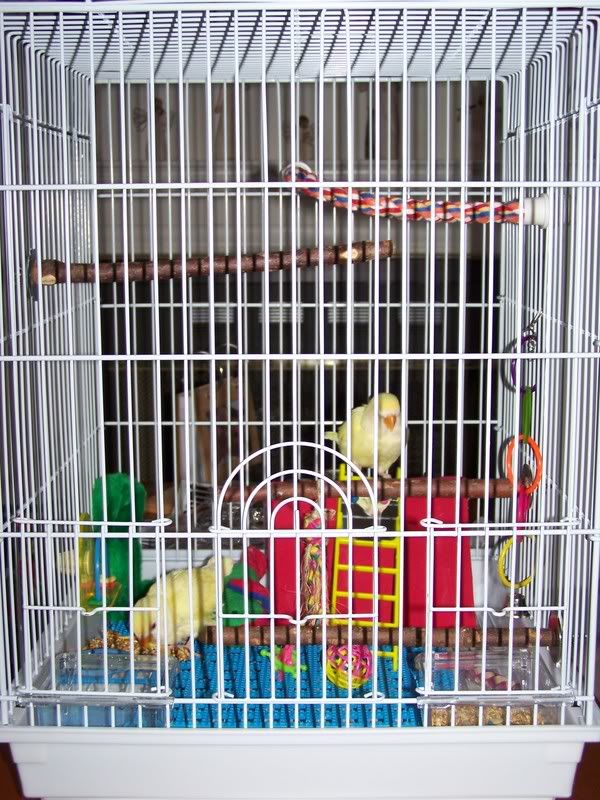
Here is our brand new bird room (sunroom, indoor aviary....whatever; enjoy!)

Posted by
Tamara
at
5:47 PM
3
comments
Labels: Aviary, birdroom, Cage Set-Up, playgrounds, Playtime
Our birds are crazy! This is what happens everyday when we feed them.
Posted by
Tamara
at
7:34 PM
0
comments
Labels: twitter

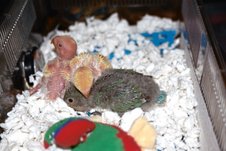
2 weeks old: 5 feedings every 4 hours (8:00am, 12:00pm, 4:00pm, 8:00pm, 12:00am.) Many other breeders only feed 4 times every 4 hours the first week, but we do not want the babies crying for food in the middle of the night. Just like human babies, there are small babies (Pixy!) and there are large babies (her brother Jelly Bean!), so the amount of food is going to vary around 3.5-4.5 cc’s. Tamara and I do not say, “Ok baby, you have had 4 ccs, your full!” No, we fill up the babies until their crops resemble a full balloon or when they simply do not want anymore. Feed the babies all at once; competition is your greatest ally. Well-socialization goal: babies should recognize you, have a wonderful feeding response, and have names.
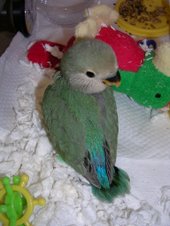
3 weeks old: 4 feedings every 4 hours (8:00am, 12:00pm, 4:00pm, 8:00pm.) Just fill those crops until they look and feel like a full balloon. At 3.5 weeks old, the babies will start to chew on their bedding. This is the time to introduce “big bird” food. Fresh, chewy Avicakes are the perfect introduction to solid food. Avicakes are highly nutritious unlike seed or millet. After babies are fed baby food, place a very small crumb into their mouths. This works great as a birdie pacifier also. We never feed them mashed-up or soft foods for weaning. Starting them on what they will eat as adults is best. After they are eating “big bird” food, we introduce small foot toys and toys they can shred. Well-socialization goal: babies try “big bird” food, recognize your voice, and step-up on your palm to be fed.
4 weeks old: 3 feedings every 6 hours (8:00am, 2:00pm, 8:00pm.) We never drop their feedings to three until we know they are eating the Avicakes on a regular basis. This is the time when we introduce crushed-up Nutri-Berries and a small pellet like Roudybush Crumble. Depending on the size of the baby, they should be receiving around 6 ccs at this point. Once again, feel the crop and if the babies refuse, do not force them to eat. After we feed them baby food, we place them over the solid food bowl. This is the time we introduce a small dish of water also. Well-socialization goal: babies play with toys, eating adult food on a regular basis, and cry out not only for baby food, but for attention also. Some of the older babies at this point have a natural protective instinct of their siblings and territory, so to dilute this trait we lay down on the floor, cuddle, play with them with their toys, and feed them adult food by hand after each feeding. When they have fallen asleep, we place them back into the brooder.
6 weeks old: 1 feeding per day at 6:00pm or 8:00pm (babies can feed from 7-10 ccs at this point.) If we have a large clutch, 4 or more babies, the prodigies will normally wean during this week. Well-socialization goal: babies are filling up on adult food in the morning, babies want to come out of their weaning cage to fly, cuddle, and most importantly play with toys independently on a playground. Babies should never be on a person all the time when they are outside of their cages. They have to learn independent play and have foraging opportunities.
7 weeks old: A baby should wean at anytime now. If they do not cry for their evening feeding, then do not give it to them. At 7 weeks, we introduce cooked foods, fruits, sprouts, and veggies. The babies will see the adults eating the food and will follow their lead. Many breeders and pet stores separate their babies in individual cages so they will not bond with each other. This is one of the worst things they can do for a baby, especially one that has not weaned yet. Birds need that competition of the food bowl, thus learning to eat on their own and whenever food is presented. Lovebirds that also learn to compete for food will naturally compete for your attention also thus making trust issues virtually nonexistent. Well-socialization goal: the babies step-up from inside their cage, and the babies are excited to see you. Babies need a reason to want to come out of their cages such as a playground. That, plus routine, is the key to a well-socialize parrot and not one that is caged bound and only finds security in the confounds of their bars.
8 weeks old: Weaned. If you decide to clip, never clip a bird before they wean or they might not ever see a reason to get off the baby food. This is nature’s way: stop begging, get off Momma’s fat baby food, and fly! Even though socialization starts as early as two weeks, true socialization actually starts the week babies wean. Too many times we have seen and heard stories of birds that were handfed, but they turned wild. It happens during this week. The babies no longer need you as a source of food, so you need to show them that they still need you for other reasons: love, another source of fun, security, and socialization. During this week, most birds forgot you ever handfed them. All handfeeding does is that it gets a bird use to the presence of humans. So during the week your babies wean, the most important thing any of us can do is to continue a balance of training, positive reinforcement, cuddle time, and independent play. Why is a well-socialized parrot such an important goal? The simple answer is because they will live with people. If a bird is truly trust worthy, affectionate, and socialized, then chances are their humans will see them more than just birds in a cage, but as true family members. Thus, living a full and enrich life in a human household. Well-socialization goal: babies enjoy a great head rub and have first full vet check from an Avian Veterinarian.
~Rodney Money True Love Aviary
For general questions:
trueloveaviary@trueloveaviary.com
Members of:
Written by one of the owners of this Aviary, it chronicles the story of how Rodney got his love for parrots, how his life was changed, and asks for help to reconnect with his lost friend, George.
"Lovebirds are just the Jack Russell Terriers of the parrot world." ~Tamara
"They are either in play mode or sleepy cuddly mode. You won't really find them in between. Maybe on a few occasions..." ~Rodney
"I never thought I would be a lovebird person. But man, I wouldn't give them up for anything!" ~Rodney
"Lovebirds are addictive." ~Tamara
"Lovebirds are big birds in little bodies." ~Rodney
"True love is telling your spouse they have bird poop on their shoulder." ~Rodney
"Birds are like potato chips, you can't stop at one."
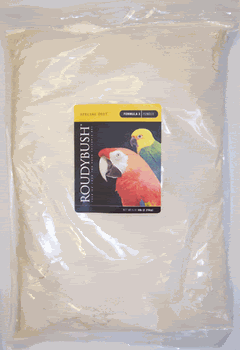
This is the handfeeding formula we use. We used to use Exact Handfeeding formula before we were advised by our vet, Dr. Burkett, that Roudybush formula was way better for babies.
Wow, did we sure notice an immediate change in our babies! We, at first, were puzzled why a few babies in the first clutch we switched over were crying in the middle of the night. We were feeding them the same amount of Roudybush that we had with Exact.
In discussing the change further with Dr. Burkett, we discovered that the babies weren't getting enough food! Why was that? Well, the Exact Handfeeding formula did not digest very well and would stay in the crops for a long time (this can create complications alone). The Roudybush formula was actually digesting and the crop emptying faster!
The babies plumage and health has definitely improved since switching to this formula. We highly recommend it!
Handfeeders: You can get it here
During the weaning process we allow our older birds to demonstrate eating, playing, etc.
All in all, we are continually discovering new things about raising babies and new ways of weaning them. We are kept on our toes with every clutch!
This is the best scale we have used. It comes with an AC adapter, a perch securely mounted to a platform, a separate removable platform, and weighs in 1 gram increments.
You can find scales that are priced lower; but you will not find one better. Just think, if you bought a postal scale, what would the bird perch on. You would also need to purchase an adapter. This scale is made for the bird person.
You should weigh your bird regularly and keep a log. This way, you can provide important information to your veterinarian, and you may spot health problems earlier.
This is what our log looks like:
You can get it Here!
Fast-acting gel to stop bleeding; disinfects, too. More convenient and sanitary than powders, and less expensive! New easy-to-use syringe applicator.
We recommend this product over anything else!!! It doesn't sting or clump up like Kwik Stop. Dr. Burkett recommends this product as well! It is safe and effective!
As always, if you have an emergency situation with bleeding, apply pressure and take to your nearest Avian Vet or Emergency Clinic!
Photo from caiquesarepeopletoo.homestead.com (Trouper and Ripley)
BeBe decided to hold a special meeting with the entire flock.
Hedwig: "I could let Mia bite my foot and make it bleed all over the place again. They seem to really enjoy patching me up and giving me a bath! Lovebirds like us like to play rough."
Dewey: "Hedwig! Are you freakn' kidding me? Nobody wants you bleeding all over our new sunroom again, and I especially don't want you to bleed all over my beautiful feathers. Just thinking about it makes me want to preen. And by the way, how many times do we have to tell you, 'YOU ARE NOT A LOVEBIRD!' You are a budgie!"
Baby Tootsie: "I could let them start hand feeding me again. They just LOVED feeding me night and day for weeks, and weeks, and weeks, and..."
BeBe: "Everyone had great suggestions, but lets just throw our toys, food, and poop more on the new carpet. They seem to really enjoy vacuuming and scrubbing the carpet on their hands and knees since they do it everyday. Everyone agree?"
I never realized that there was something missing in my life. I was shocked when I realized it was my lovie, BeBe. You see, I knew when I got married that I was marrying a parrot person. I had never owned a parrot in my life! I was under complete misconceptions about parrots in general. Then, we were approached with a decision to accept one of the smallest parrots into our family. Honestly, I had no idea what I was getting into and the love that I would experience for so small a life.
BeBe was a wedding present to my husband and I. He became part of our family in mid-October 2005. He was about 3 months old, but not yet weaned. The story goes that at the home of the breeders, BeBe had actually died. He got too cold and the man of the house saved BeBe by reviving him. BeBe had been almost weaned at that point, but reverted back to his baby stages and wouldn’t get out of them until he was almost 6 months old.
Some people would call BeBe spoiled. I would merit saying, instead, that he is extremely spoiled, well, and extremely loved. We consider him our child, so, in essence, we are normal parents in wanting to give BeBe the best life. People noticed a difference in him right away. Suddenly, we were breaking the bad rap that lovebirds had gotten. The exposure of sweet, loving, playful lovebirds was coming out through our very own baby.
BeBe has always had the most awesome toys. His cage is a plethora of stimulation. However, he remains outside of his cage most of the time. He loves his Penn-Plax playground and Hide-N-Peek Ball especially. Some people might call us extravagant in how we spoil our birds. I just call it a good investment into a long and happy life with them.
People are impressed with BeBe. Though he is small in size, he still stands out in a crowd of other birds. He knows a number of tricks and also how to get into trouble! He prefers to eat off of our plate and go down our shirts. That doesn’t quite work out when we have guests. In one instance, we had a couple over that we were friends with. I was called to rescue BeBe when he went down the shirt of the female guest!
He loves to give kisses. I suspect that if given the chance, he would just kiss me all day. If I ask him if he loves me, he makes a kissing noise at me. Sometimes you will catch him kissing every person he visits when we take him out. Another way he shows his affection for us is by regurgitating on us. Most of the time, it is him going through the motions rather than really anything coming up.
He loves to play “Where’s BeBe?” which is basically a version of Peek-a-boo. He has a great, unique call when he comes out and I say, “There’s BeBe!” It was that call that helped reunite us when he accidentally flew out the door.
After his first molt, we decided to let him keep his flight feathers for a little while. That was until I frightened him when I was putting a box outside my front door. Never in my life, have I been so upset and scared. He took off out and around our apartment building out of my sight. I dashed down the stairs and started calling his name in hysterics. Then I heard the most beautiful sound. He called back to me. Soon, BeBe was back in my arms. I truly didn’t realize how much I loved him until I almost lost him. Needless, to say, I was truly blessed to have him back as many people are not so fortunate.
BeBe loves to snuggle. He loves doing his tricks. One of the funniest antics he has is when he imitates a helicopter. He makes the chopping sound and moves around in circles. He also likes to imitate a circus elephant by trying to balance himself on a ball. He loves to play fetch, of course, as we “fetch” and he throws. We’ve been working on one trick for a year now, and I finally think he’s got it down. I ask him if he has fleas, and he pulls his little agile leg over his wing and scratches his head. Of course, his favorite rewards are verbal praise and head rubs!
We decided recently to share our little blessing by raising lovebirds with a similar demeanor. BeBe’s true quality comes out in how he is an example to the new babies. He pays attention to them and cares about them, even so much as to try and regurgitate to them. Many of our new babies have weaned faster by watching BeBe and his actions. He cares so much for other birds that he sometimes risks his own life to visit with birds much bigger than him! We all know, however, that lovebirds are big birds in little bodies anyways.
Most of all, BeBe has taught me how to love deeper and be more patient. We are his flock, his family, his mate. He has given me a new reason to get up early every morning, to play more, and has taught me how to be a better person. I think it is all in learning to love and care for the smallest of deliveries into our lives.